

News Center
A modern veterinary drug GMP pharmaceutical enterprise relying on high technology, integrating scientific research, development, production, sales and service
Several common diseases of pig skin redness in summer
Release time:
2022-06-22
When the weather turns hot, the symptoms of red spots on pig skin are more common. The following is a brief introduction to the difference and treatment of four common diseases to facilitate the differential diagnosis.
1. Eperythrozoonosis
The main reason is that there are a large number of needle-like bleeding points behind the ear root, which are diffusely exuding from the pores (this is typical). Looking at the pig's abdomen from a distance, iron embroidered bleeding points can be seen.
Features:It is anemia, jaundice, missed heat (eat after injection, continue to have fever without injection), needle-like bleeding points, redness of the skin in the early stage of the disease, pale skin in the later stage (mainly caused by anemia), yellowing and emaciation, and urine changing from yellow to soy sauce color (mainly caused by hemolysis).
Eperythrozoonosis can be effectively prevented by first eliminating mosquitoes and flies (these two are the main media for the transmission of eperythrozoonosis).
If eperythrozoonosis has occurred, long-acting oxytetracycline and sulfonamides can be injected intramuscularly. Oxytetracycline hydrochloride or sodium sulfamonomethoxine can also be fed.
2. Swine erysipelas
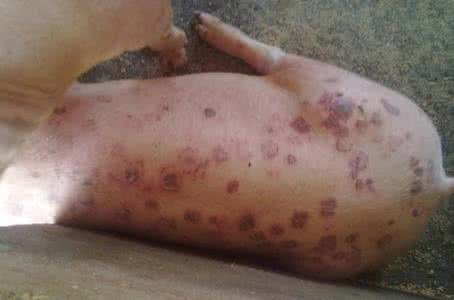
Erysipelas is widely distributed and occasionally transmitted to other pigs. The skin on the back has square, rhombus or ring rashes (pale in the center and red around, commonly known as "spark marks"), and the rashes protrude from the skin surface. Most pigs have fever, and shelf pigs are frequent. Especially in summer, the rashes are faded by finger pressure. Penicillin has a better effect on the disease.
Bupleurum (demi, analgin, compound aminopyrine) penicillin treatment, pregnant sows do not use rice, treatment of the disease with penicillin is the best, followed by oxytetracycline, tetracycline, enrofloxacin, chlortetracycline and tylosin.
3. Ring dermatitis type
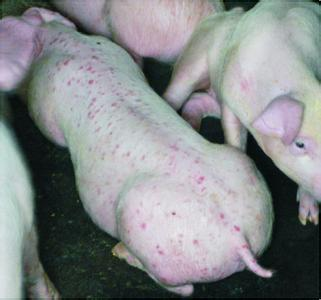
There are many clusters and the spots are much smaller, and the influence of eating and drinking is not obvious. Erythema, spots and papules of various sizes are mainly found in the ears, back, abdomen, forelimbs, hind legs, buttocks and other parts of the sick pig. The round or irregular protuberance is red or purple, and the central black lesion lasts for a long time, and the finger pressure does not fade. The inguinal lymph nodes of the sick pigs are obviously swollen, antibiotic treatment is ineffective.
First do a good job of vaccine immunization:Reserve sows can be immunized once before mating. Sows are immunized with fetuses; Piglets are vaccinated for the first time at the age of 2-3 weeks, and the immunization is strengthened once at intervals of 3 weeks (the immunization procedure needs to be determined according to local conditions, which is for reference only).
Antibiotics can be used to reduce concurrent infections, such as Lin can be treated with spectinomycin, while the application of drugs to promote renal excretion and alleviate the recovery of the kidney.
Selection of new antiviral drugs:Such as interferon, immunoglobulin, at the same time with Chinese herbal medicine disease resistance such as astragalus polysaccharide plus penicillin is better.
4. Mosquito bites
Usually it is suddenly covered the next day, because it is mostly bitten at night.
Mosquito repellent, drug-based; Piglets can be solved by spraying toilet water or other skin diseases.
diagnostic ideas
1. See if you have a fever.Eperythrozoon and swine erysipelas will have fever symptoms, ring and mosquito bites normal body temperature. In case of fever, the erythrocyte acupressure does not fade, and the porcine erysipelas acupressure fades and fuses together.
2. Is it acute onset.In the case of acute onset, mosquitoes are the main consideration for individuals and swine erysipelas for groups.
3. According to the skin lesions to identify.Eperythrocytes are mostly needle-shaped hemorrhagic spots, porcine erysipelas are mostly square, rhombic or circular regular rashes, with rings showing extensive erythema, spots and papules of different sizes, round or irregular bulges, red or purple, and black lesions in the center.
More news
Contact Us
Administrative service telephone:0532-85212368
Sales Advisory Phone:0086-532-85212381
E-mail:zhongrenyaoye@126.com
Address: No.6 Road, Jiaoxi Industrial Park, Jiaozhou City, Qingdao, Shandong Province

Qingdao Zhongren Animal Medicine Co., Ltd
Zhongren Aquatic Products