
How can ventilation management in chicken houses be effectively implemented?
2026-06-05
Ventilation is an essential management practice in modern poultry farming. Maintaining adequate ventilation in the chicken house helps keep the air fresh, ensures a sufficient supply of oxygen, and creates an optimal temperature‑and‑humidity environment for the flock, thereby helping to reduce disease incidence caused by environmental stress. There are various methods of ventilating a chicken house, and during seasonal transitions—particularly in cold weather—it is crucial to strike a balance between ventilation and heat retention. The following sections introduce common ventilation strategies and their underlying principles.
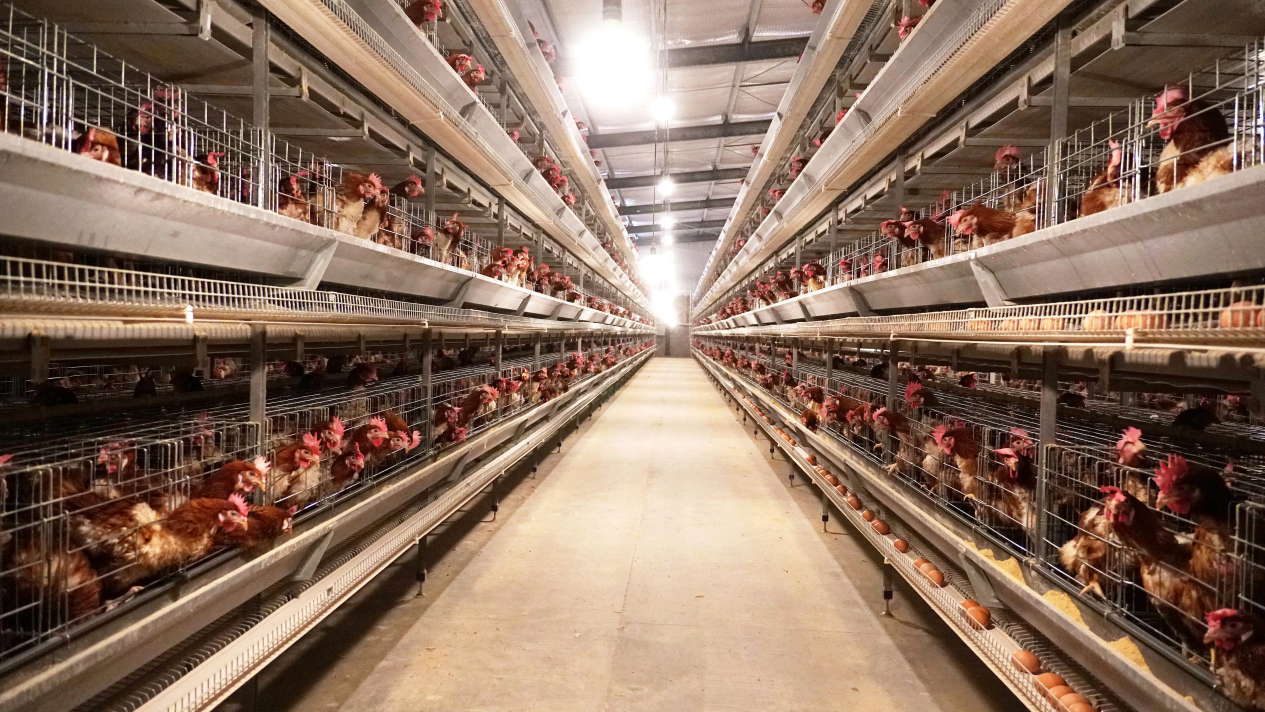
I. What are the methods of ventilation in chicken houses?
1. Natural ventilation
Traditional open- and semi‑open‑style poultry houses typically rely on natural ventilation, with air circulating through floor vents, roof windows, or ventilation strips and windows. During hot weather, natural ventilation alone often fails to provide adequate cooling. Additionally, in modern closed‑house systems, ventilation ducts and small windows are sometimes used during the early brooding phase to supplement natural ventilation and ensure proper air exchange.
2. Mechanical ventilation, negative-pressure ventilation
Currently, most closed‑type poultry houses employ longitudinal negative‑pressure ventilation. Fans are installed at one end of the house—typically on the gable wall adjacent to the manure alley—or on both side walls near the gable. Air inlets are located on the opposite gable and on both side walls. With no doors or windows, or with all openings kept closed, air flows along the longitudinal axis of the house.
3. Longitudinal Positive-Pressure Ventilation
Fans forcibly deliver air into the poultry house, while the exhaust vents are adjusted so that the exhaust airflow is slightly lower than the supply airflow, creating a slight positive pressure inside. Air is typically distributed throughout the house via longitudinally installed ducts that span the entire length of the structure; in fully stacked multi‑tiered systems, positive‑pressure ventilation is sometimes employed.
II. Four Principles of Ventilation During Seasonal Transitions
1. Common issues that arise during seasonal transitions
In spring, daytime temperatures are relatively mild—warmer than in winter but cooler than in summer—while nights are pleasantly cool, though not as cold as winter. During this period, we often perceive the weather as just right, neither too hot nor too cold, making ventilation seem straightforward. However, many poultry farms encounter several issues during seasonal transitions, which prevent them from optimizing their ventilation systems and can trigger respiratory diseases in the flock. First, insufficient side-wall air inlets fail to support an adequate transitional ventilation strategy. Second, improper system configuration occurs: when a transitional ventilation setup should still be in place, the system is mistakenly switched to longitudinal ventilation, leading to excessive airflow and stress for the birds. Third, longitudinal inlets may have poor sealing when closed; consequently, using longitudinal ventilation during the day while failing to switch to minimum ventilation at night—when temperatures drop—results in poor indoor air quality. Additionally, transitional ventilation systems are often not fully automated, giving rise to numerous unpredictable issues that compromise ventilation performance.
2. Minimum Ventilation System
When the temperature inside the chicken house is at or below the set point, we open some of the inlet vents, while the fans are operated by a timer. Therefore, only by properly programming timed cycles can we meet the birds’ needs and maintain good air quality in the house. The sidewall inlets are controlled by negative pressure, directing airflow toward the center of the roof; this not only maximizes the use of rooftop heat but also prevents cold drafts from blowing directly onto the chickens, while the heating system can be activated as required.
When operating the minimum ventilation system, the longitudinal air inlets must be tightly sealed. If these inlets are not properly sealed, the minimum ventilation system will not function effectively. Therefore, when using the longitudinal ventilation system during the warmer daytime hours and switching to the minimum ventilation system at night as temperatures drop, it is essential to ensure that the longitudinal air inlets are securely sealed. When the house temperature exceeds the setpoint, the fans are no longer controlled by a timer but run continuously, providing transitional ventilation.
3. Transitional Ventilation System
Transition ventilation falls between minimum ventilation and longitudinal ventilation. It requires increasing the number of sidewall inlets and using a combination of minimum‑ventilation and longitudinal‑ventilation fans. Air enters the poultry house through the sidewall inlets, allowing more thorough air exchange while avoiding the cooling effect associated with longitudinal ventilation, thereby minimizing stress in the flock. A prolonged transition‑ventilation phase can be employed before switching to full longitudinal ventilation.
The transitional ventilation system activates when the house temperature exceeds the setpoint: all sidewall inlets are opened, and the fans of the minimum ventilation system are no longer controlled by a timer but run continuously. In other words, all inlets used for minimum ventilation are fully open, and in some cases, a portion of the longitudinal ventilation fans may also be utilized.
4. Management of Transitional Ventilation
We know that the minimum ventilation system should be used when the house temperature is below the set point, and transitional ventilation can only be employed when the house temperature remains consistently above the set point. At that stage, increased air movement inside the house can easily cause the birds to lie flat on the floor. Therefore, we should determine the appropriate fan speed based on the flock’s behavior—paying close attention to their activity rather than relying solely on the temperature readings from the thermometer to manage the ventilation system.
Only when the flock continues to show signs of overheating even at the maximum transitional ventilation rate should you switch to a vertical ventilation system. Do not switch to vertical ventilation solely because the thermometer‑measured temperature has exceeded the threshold; doing so prematurely can subject the birds to cold stress and cause them to become chilled, often resulting in reduced activity—such as lying on the floor and refusing to move.
After each adjustment to the ventilation settings, managers should personally remain in the poultry house and, ideally, wait for about 20 minutes to carefully observe whether the flock’s activity has improved. Only then can they determine whether the ventilation settings are truly optimal. Unfortunately, most managers simply rely on their experience to instruct workers to make arbitrary adjustments to the ventilation system without further monitoring the birds’ actual response—such an approach is highly reactive and undesirable.
During the spring and autumn seasons, daytime temperatures are relatively high, typically requiring transitional or longitudinal ventilation; as nighttime temperatures drop, the system must switch to minimum ventilation. For such frequent mode changes, it is ideal if the poultry house is equipped with automated control—though in practice, automatic systems are seldom implemented. Therefore, when operating minimum ventilation at night, the longitudinal ventilation inlets should be appropriately sealed; otherwise, minimum ventilation may not function effectively. At the same time, carefully manage the timer‑based cycle duration to ensure good air quality inside the house.
That concludes the methods and precautions for ventilating a chicken coop. We hope this information is helpful. Ventilation is most critical—and easiest to implement—in summer; however, even in winter, you must never sacrifice ventilation in pursuit of warmth, as doing so can easily lead to excessive ammonia levels and respiratory problems in your chickens.
Key words:
Contact Us
Administrative service telephone:0532-85212368
Sales Advisory Phone:0086-532-85212381
E-mail:zhongrenyaoye@126.com
Address: No.6 Road, Jiaoxi Industrial Park, Jiaozhou City, Qingdao, Shandong Province

Qingdao Zhongren Animal Medicine Co., Ltd
Zhongren Aquatic Products