
Analysis of Pathogeny and Prevention of Avian Synovial Cystic Mycoplasma
2023-09-04
In recent years, Mycoplasma synoviae has become one of the main diseases that ravage the entire poultry industry. Broilers, hemp chickens, mixed chickens, native chickens, and laying hens are all deeply affected by it. For commercial broilers, it increases manpower and medication costs, reduces growth rate and feed conversion rate, higher elimination rate and carcass quality. For breeding chickens, it is manifested by irregular development of flocks and reproductive organs, and no peak or delayed peak of egg production; for breeders, resulting in more dead embryos, weak chicks, lower hatchability, incidence of up90%~ 100%Incalculable losses to the farming industry.
Mycoplasma synovium infection in chicken(MS)Also known as Mycoplasma synovium infection, synovial sac mycoplasma infection, synovial sac mycoplasma infection, infectious synovial sac inflammation, infectious synovitis, chicken and turkey is an acute and chronic infectious disease, joint swelling, synovial sac and tendon sheath inflammation symptoms.
1. pathogen
The pathogen of the disease is synovial sac mycoplasma, which is a polymorphic spherical body.(Diameter approx.0.2~0.4unr)than Mycoplasma gallisepticum(MG)Slightly smaller, Gram-negative. There is only one serotype, and the pathogenicity of different strains is different, and the symptoms caused are also different due to the tendency of the pathogen. The pathogen has general mycoplasma characteristics.
2. Epidemiology
The pathogen naturally infects only chickens and turkeys, and artificial infection can cause chicks and geese. The incidence of imported varieties or strains was higher than that of local varieties. Egg-infected chicks visible1onset within weeks.4~16week-old chicken and10~24Weeks of turkeys are more common. The disease is mainly transmitted through the contact level of healthy chickens and sick chickens, and the respiratory tract is the main horizontal transmission route of the disease..The trachea is the main target tissue. The vertical transmission of the egg is more harmful. In a flock of chicks10%~20%Egg-infected chickens.It can be spread throughout the entire flock of chickens in a very short time. The peak of transmission through eggs is after population infection.1~2Months, the pathogen lurks in chickens for several days to several months. Once the chickens are stimulated by adverse factors, they will soon become ill. In addition, flocks are infected by contact with feed, clothing, animals and feeding utensils contaminated with pathogens. The vaccine produced by common chicken embryo culture is often contaminated by synovial sac mycoplasma, which can cause infection in vaccinated healthy chickens.
Mycoplasma synoviae is sensitive to cold, hot, dry and general disinfectants.Because there is no cell wall protection, the ability to survive in the environment outside the host is very poor. May survive for several days in a cold and humid environment.But it can only survive for a few hours in a dry and hot environment. If the empty house is long, there is no ability to exist in the chicken coop. For non-full-out chicken farms, chickens infected with Mycoplasma synoviae are infected for life, and pathogens can also be isolated from the trachea of normal-looking chickens. Constant and recurring infections are the main cause of the disease..Continuous drug and vaccine prevention can only reduce the incidence of disease..It cannot be completely purified. The incidence of chicken and turkey up90%~ 100%,But the mortality rate is usually1%The following,Maximum not exceeding10%.
3. clinical symptoms
At the initial stage of infection, the sick chicken is still in good spirits and has a normal diet. If the course of the disease is a little longer, he will be in low spirits, be alone, lie down, often stay beside the trough and sink, decrease appetite, stagnant growth, emaciation, dehydration, pale cockscomb, and in severe cases, the cockscomb will shrink and turn purple. Typical symptoms are swelling, lameness, and even deformation of the tarsal and metatarsal joints; in chronic cases, the keel of the chest is induration, which softens into thoracic cysts. Adult chickens have mild symptoms, with only swollen joints and weight loss. Respiratory cases: manifested as sneezing, coughing, runny nose, often live vaccination or other stress such as beak, strong wind cooling after respiratory symptoms, discharge of green feces.
4. pathological changes
articular case
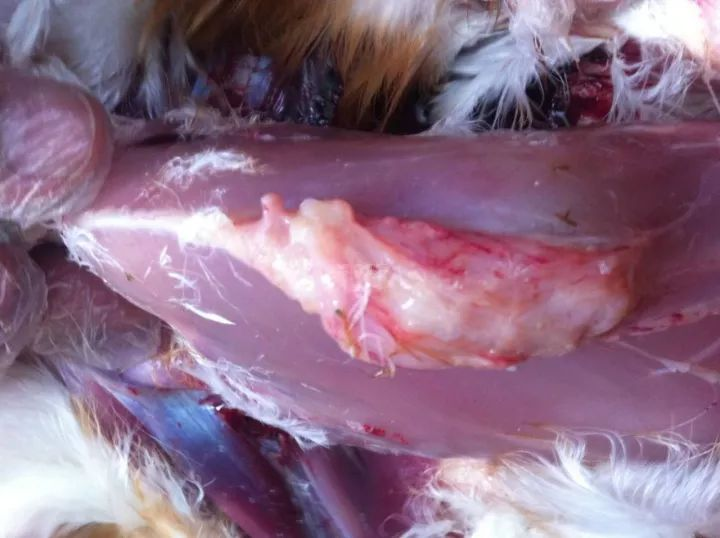
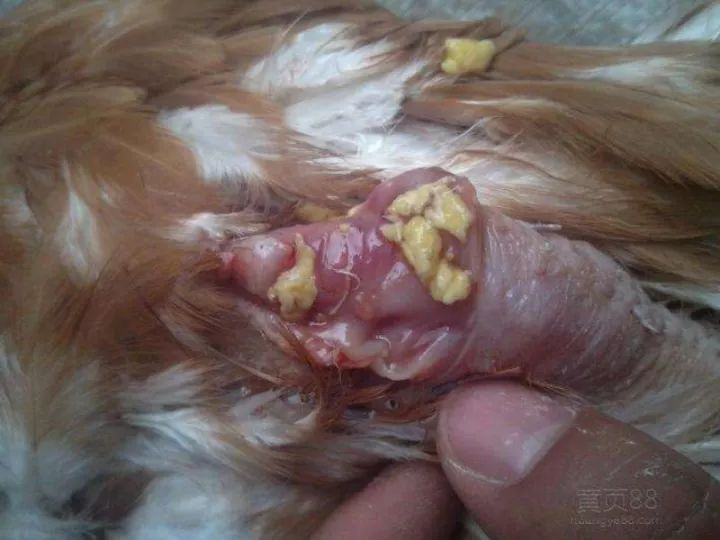
Often appear tenosynovitis, synovitis and osteoarthritis, disease at the beginning of edema, exudate, yellow or gray, clear, sticky, with the course of the disease, gradually turbid, eventually cheese-like. In severe cases, cheese is even present on the top of the head and above the neck. The affected joint is orange-yellow, sometimes erosive articular cartilage is examined histopathologically, soft tissue edema tendon sheath and synovial sac cavity with heterophile cell infiltration followed by mononuclear cell and plasma cell infiltration and thickening, sometimes heterophile cell inflammatory changes extend to the underlying bone, the formation of cellulose-like degeneration. Internal organs generally do not see characteristic lesions.
respiratory case
There is mucus in the trachea, due to mononuclear cell infiltration and reticular cells, and hepatosplenomegaly, liver is mottled rose green, kidney may also be swollen, white. Lymphocyte degeneration may result in atrophy of the thymus and bursa, and sometimes pericarditis, epicarditis, and endocarditis.
5. prevention and control
Control of the disease is mainly through drug control and vaccine immunization two methods.
1Prevention
In terms of vaccine immunization, there is no successful vaccine on the market in China, and abroad there are inactivated Mycoplasma synoviae cyst vaccine and Mycoplasma synoviae cyst vaccine.HStrain live vaccine for production, the price is higher. synovial sac mycoplasmaHThe strain vaccine itself has no pathogenicity. It can be permanently colonized in chickens by eye point immunization, and can reduce the vertical transmission caused by wild poison, which is necessary for breeders.
2Treatment
① Pick chicken to eliminate:
Seriously sick chickens have no therapeutic value and are eliminated directly.
② Medication:
Note: Many cases of synovial cystic mycoplasma in chickens are mixed with Escherichia coli, streptococcus and staphylococcus.
So in the treatment, can cooperate with some antibacterial drugs, the treatment effect is better.
Programme I:"Kexi”+“Slow Dick"Drinking water at the same time."Zhiyuanjing"Mixing material, used together4-5Day.
Programme II:"Cassino"Inject once,"Kexi”+“TimicoxingDrinking water orZhiyuanjingMixing material, used together4-5Day.
Programme III:"Kexi”+“Tavanectin"Drinking water, used together4-5Day.
③ Strengthen management and disinfection.
6. Summary
So far, there is no medicine that can remove the pathogens that exist in the chickens, but can only control the basic disease.
Only by strengthening management, providing a suitable feeding environment and reducing stress can the incidence of the disease be reduced. Implementing a full-in and full-out feeding model, increasing batch intervals, strengthening disinfection and quarantine, and eliminating sick chickens can reduce the probability of the disease and reduce economic losses.
Key words:
Previous:
Contact Us
Administrative service telephone:0532-85212368
Sales Advisory Phone:0086-532-85212381
E-mail:zhongrenyaoye@126.com
Address: No.6 Road, Jiaoxi Industrial Park, Jiaozhou City, Qingdao, Shandong Province

Qingdao Zhongren Animal Medicine Co., Ltd
Zhongren Aquatic Products